As a part of my foodservice rotation I had the opportunity to work in a kitchen at Riderwood Village, a retirement community. But this wasn’t just any kitchen; Renaissance Gardens is a specialty kitchen on the campus, catering to the needs of residents in assisted living facilities or skilled nursing facilities. On top of preparing regular meals, they also make meals for residents needing modified textures, such as mechanical ground or chopped, or pureed. My partner and I actually helped prepare a pureed meal consisting of collard greens, corn pudding, and baked chicken. I was surprised to learn the techniques used to obtain the perfect pureed consistency. To puree the chicken, we used broth, water, and cornstarch to make sure it wasn’t too watery or too dry. We even got to sample the pureed meal; it was actually pretty good! I was amazed at how similar the pureed chicken tasted to the regular version.
After sampling, Chef Willie, the Chef de Cuisine in the kitchen, explained to us the upcoming implementation of a puree molding program, which will use food molds to make the pureed foods look more like the original. They’re hopeful that making the pureed foods look more pleasing will increase resident satisfaction when consuming the meal. Chef Willie is extremely motivated and excited about the puree molding program, so I’m sure it’s going to be a hit!
I enjoyed my time in the “RG” kitchen and picked up some useful skills that are going to be very helpful when my partner and I host our theme meal, “Strawberry Patch Brunch,” for residents in the independent living facilities. Stay tuned for details and pictures from that!
Tuesday, April 24, 2012

A Baltimore Weekend – Sports, Cardiovascular, and Wellness Nutrition
This last weekend some of the University of Maryland College Park interns were given the opportunity to volunteer in exchange for free admission to the conference. I was so excited and have been looking forward to this conference for months. As some may know, I am very passionate and interested in sports nutrition so this was a perfect symposium for me to attend, not to mention that I am also a member of the SCAN DPG.
For those of you who are not familiar with SCAN, members of Sports, Cardiovascular, and Wellness Nutrition (SCAN) are “experts in nutrition for athletic performance, fitness and weight management, cardiovascular health, wellness, and in the prevention and treatment disordered eating and eating disorders.” 30 years ago SCAN started off to a slow start but grew exponentially with support every year and is now the largest DPG in the Academy with almost 7,000 members and just celebrated its 28th national symposium. This year’s symposium was in Baltimore and brought out over 400 people from all over the country.
My top 2 favorite presentations were:
· “Train to Manage Pain: How the Foods We Eat Can Optimize Exercise Recovery” by Leslie Bonci MPH, RD, CSSD, Kerry Keuhl, MD, DrPH, and Leanne Shear
· “Fueling for Power and Strength” by Paul Goldberg, MS, RD, CSSD, CSCS
Top 5 Quotes of the weekend:
· “To train with pain sends athletes down the drain” –Leslie Bonci
· "Eat food with color in it, that's not a skittle" –Leslie Bonci
· "The tsunami in the ocean is poor blood glucose control, diet and exercise are the prevention" –James Rippe
· “Discipline is a muscle and it fatigues” –Dan Buettner
· “You can't spell ‘nerd’ without RD” –Jon Vredenburg
My classmates and I tweeted throughout the whole symposium with the designated hashtag of #SCANsymposium. I think I logged over 85 tweets full of information from the presentations, quotes, pictures, and comments about exciting updates from SCAN. For more information on this follow me @ErikaWincheski or any of my classmates who also joined ( @SashaBaRD, @rccoury, @AngelaAFarris, and @JoyceLHornick).
I cannot wait until next year’s symposium in Chicago!
Friday, April 13, 2012
Clinical: doing it well
As I dive deeper into my clinical rotation, I’d like to take this opportunity to reflect on what I’ve learned about being a clinical dietitian. Aside from the clinical experience itself, I had the benefit of working with a variety of clinical dietitians to pull techniques, shortcuts and tricks from. I’ve learned that there is not one right way to be a clinical dietitian – there may not even be a best way. Throughout my journey I was impressed by a clinical dietitian with a compassionate bedside manner, and equally impressed by a dietitian who was rarely able to speak with her intubated patients, but knew their whole medical plan of care as well as the most current, evidence-based approach to their nutritional treatment. I was amazed by the speedy, efficient work of one dietitian while admiring another’s greatly detailed and thorough reports.
It has been a relief to discover that a variety of personality types make good clinical dietitians. The important factors in becoming “good” are to know your strengths, practice to your strengths, and stay passionate about your work!
The shortcuts and tricks I learned from the clinical dietitians I’ve worked with thus far are as follows:
- Start the day by organizing your patients – color code
- As you’re jotting down patient information, plan for the patient interview by highlighting areas you need to ask about
- I repeat: use a highlighter
- Create your own shorthand
- Use the fishbone to record lab work – it doesn’t take long to learn
- Talk to the nurse! They can tell you key info faster than you can look it up
And feel free to add your own.
Thursday, April 12, 2012
Renal Nutrition for BBQ Season
By: Sasha B. Bard, MS, Dietetic Intern
A few posts back one of my fellow UMD dietetic interns, Joyce Hornick, wrote a blog about her experience with renal nutrition.
Unlike Joyce, I had been in a dialysis center prior to my renal rotation. My mother is a social worker in a dialysis center in Richmond, Virginia and during graduate school I would go to work with her when I was in town and spend time shadowing her dietitians. From my experiences in both Virginia and Maryland, I completely agree with Joyce- renal dietitians are impressive! They have to wear many hats. One minute an educator, the next a clinician. And at times a cheerleader, a chef, or a counselor.
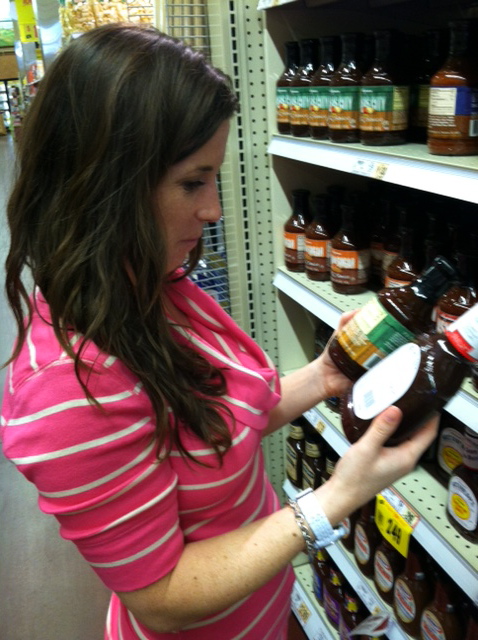
One of our projects during the renal rotation was to go to the grocery store and compare the nutrient content of various condiments. With barbecue season right around the corner, we wanted to see how much sodium, phosphorus, and potassium there was in some of the popular condiments. My partner, Erika Wincheski, and I looked through bottles and bottles of ketchup, mustard, hot sauce, worcestershire, and BBQ sauces.
Not surprisingly, we discovered that many of the sauces have a high sodium content. Especially barbecue sauces! It varied from brand to brand, but we found some BBQ sauces with 175 mg of sodium per serving and others with over 500 mg of sodium per serving. And keep in mind that a serving of sauce is only 2 Tb! I bet there are a lot of people who use more than 2 Tb on their chicken.

After the investigation we put together a handout for the dialysis patients that included a dialysis-friendly recipe for homemade pulled pork barbecue. The DaVita recipe had dialysis-friendly ingredient modifications, such as salt-free ketchup and Sunny Delight in place of orange juice. (Did you know that 1 cup of orange juice has 430 mg potassium, whereas 1 cup of Sunny Delight only has 23 mg potassium?!?) And it's always best to convince people to try a new recipe with a taste test, so we passed out samples during the patients' treatment. Luckily, it was a hit!
A few posts back one of my fellow UMD dietetic interns, Joyce Hornick, wrote a blog about her experience with renal nutrition.
Unlike Joyce, I had been in a dialysis center prior to my renal rotation. My mother is a social worker in a dialysis center in Richmond, Virginia and during graduate school I would go to work with her when I was in town and spend time shadowing her dietitians. From my experiences in both Virginia and Maryland, I completely agree with Joyce- renal dietitians are impressive! They have to wear many hats. One minute an educator, the next a clinician. And at times a cheerleader, a chef, or a counselor.
One of our projects during the renal rotation was to go to the grocery store and compare the nutrient content of various condiments. With barbecue season right around the corner, we wanted to see how much sodium, phosphorus, and potassium there was in some of the popular condiments. My partner, Erika Wincheski, and I looked through bottles and bottles of ketchup, mustard, hot sauce, worcestershire, and BBQ sauces.

Not surprisingly, we discovered that many of the sauces have a high sodium content. Especially barbecue sauces! It varied from brand to brand, but we found some BBQ sauces with 175 mg of sodium per serving and others with over 500 mg of sodium per serving. And keep in mind that a serving of sauce is only 2 Tb! I bet there are a lot of people who use more than 2 Tb on their chicken.
After the investigation we put together a handout for the dialysis patients that included a dialysis-friendly recipe for homemade pulled pork barbecue. The DaVita recipe had dialysis-friendly ingredient modifications, such as salt-free ketchup and Sunny Delight in place of orange juice. (Did you know that 1 cup of orange juice has 430 mg potassium, whereas 1 cup of Sunny Delight only has 23 mg potassium?!?) And it's always best to convince people to try a new recipe with a taste test, so we passed out samples during the patients' treatment. Luckily, it was a hit!
Thursday, April 5, 2012
Adventures in Pediatrics
By: Rachel Coury
I was able to see a young girl with Pica (a disease I thought only existed in textbooks) who preferred eating her hospital bracelet to an actual meal of food and performed an initial and follow-up assessment on an adolescent female with a redundant colon. This patient had been suffering from chronic constipation since age 4 prior to the discovery that she had extra loops of bowel in her large intestine making it more difficult for waste to pass through. She came to CNMC to get a colectomy and is hopeful that post-op her constipation issues will be a thing of the past.
My second week at Children's provided just as many interesting experiences. My preceptor covered the intestinal rehab, bowel/liver transplant, and home TPN services. I was impressed by her ability to whip out a TPN faster than I could whip out my calculator. She was part of a unique team who work with children who have short gut. Some of the kids have as little as 10 cm of their bowel remaining (compared to a normal bowel length of ~400 cm), which puts them at severe risk for malabsorption, dehydration, and poor growth. The intestinal rehab team works to ween these kids off TPN as they slowly advance their enteral feeds (we're talking 1 ml per week here if they're lucky). Their goal is to get the kids' short gut to function as closely as possible to a bowel of regular length and maintain adequate hydration as these kids' can suffer from extensive intestinal losses.
As you can see, my experience at Children's was very enriching and exciting. I'm sad to call tomorrow my last day here but am excited to move on to my next site and continue my progression towards becoming an RD.
Until next time!
Can Reading a Story Actually Teach Nutrition Behavior Change?
“Read For Health” a new Maryland SNAP-Ed curriculum focuses on Interactive reading and activities to encourage healthy eating. At Baybrook Elementary School’s After School Program - Maryland SNAP-Ed Educators (including UMCP dietetic interns) participate in reading nutrition related books like – “WHO NEEDS TO EAT RIGHT”. Some of the children have reading roles…….

……..while others read along and help if we might miss a word or two.

After the story is read – the activity (“the real fun”) begins. With this story the children make a healthy snack that they can eat a little during the program, but also get to take them home or share later with friends.


The excitement and the interactions this creates are amazing and simply fun to be part of. Nutrition Education can also be fun!
Tuesday, April 3, 2012
What's the Risk?
During clinical rotation, interns spend eight weeks learning the ropes of a clinical dietitian and two more weeks putting their new skills to the test in staff relief. I am excited to announce that I am heading into my second week of staff relief, and it is flying by too quickly! I am finally getting comfortable on my unit, which includes patients from Med Surg and Critical Care. The biggest challenge with these patients is assessing their nutritional risk. When considering if a patient is at a high or low risk, it is important to look at the bigger clinical picture.
Here are some quick tips for determining the patient's nutritional risk:
Here are some quick tips for determining the patient's nutritional risk:
- Was the patient well nourished or malnourished prior to admission?
- Does the patient's diagnosis increase calorie and protein needs?
- What type of diet is the patient tolerating: clear liquids, full liquids, or general?
- If the patient is not tolerating the diet, how many days of inadequate intake?
- Do the patient's medications affect appetite or cause nausea, vomiting, or constipation?
- Are there any swallowing or aspiration concerns?
- Last but not least, does the gut work?
Coming to these conclusions is not always an easy task because it involves communication between many disciplines of the medical team. However, collecting this information is imperative to assess the whole clinical picture of the patient. With this information, I can make an accurate assessment of the patient's nutritional risk and develop a plan of care that best meets his or her prescribed nutritional needs.
Subscribe to:
Posts (Atom)